

LEAN InSight
by Dr. Marc Hermo IV, DBA, CLSSMBB
LEAN: Lead. Enable. Accelerate. Nurture.
Lead with vision, clarity, and accountability.
Enable people, teams, and processes to perform better.
Accelerate improvement, innovation, and measurable results.
Nurture a culture of excellence, learning, and continuous improvement.
The Three Pillars of Operational Excellence
Organizations across industries continue to invest heavily in improvement and transformation initiatives. These efforts often include process improvement programs, digital transformation projects, and capability-building initiatives aimed at enhancing organizational performance.
Yet despite these investments, many organizations struggle to achieve sustainable results.
One common reason is this:
Operational excellence is often treated as a single initiative, rather than an integrated system.
In practice, sustainable performance improvement requires the alignment of three critical elements: process discipline, digital enablement, and a continuous improvement culture.
The Three Pillars of Operational Excellence
- Process Discipline
At the foundation of operational excellence is process discipline.
Methodologies such as Lean Six Sigma provide a structured, data-driven approach to understanding and improving processes. Through tools such as process mapping, root cause analysis, and the DMAIC (Define–Measure–Analyze–Improve–Control) framework, organizations can:
- identify inefficiencies and waste
- reduce variation and defects
- improve process consistency and reliability
Process discipline ensures that improvement efforts are systematic rather than ad hoc, enabling organizations to address the root causes of operational issues rather than merely treating symptoms.
- Digital Enablement
While process discipline establishes a strong foundation, digital enablement allows organizations to scale and accelerate improvements.
Technologies such as automation, advanced analytics, and artificial intelligence can significantly enhance operational performance by:
- reducing manual effort
- improving processing speed
- enabling real-time decision-making
- enhancing data visibility and insights
However, digital technologies are most effective when applied to well-designed and stable processes. Without prior process improvement, organizations risk automating inefficiencies rather than eliminating them.
Digital enablement, therefore, should be viewed as a complement to process improvement, not a substitute for it.
- Continuous Improvement Culture
The third pillar—often the most challenging to develop—is a continuous improvement culture.
Sustainable operational excellence requires more than tools and technology. It depends on the ability of the organization to:
- foster employee engagement in improvement initiatives
- build problem-solving capabilities across teams
- ensure leadership commitment and sponsorship
- align improvement efforts with strategic objectives
Without cultural alignment, even well-designed processes and advanced technologies may fail to deliver long-term results. Improvements may be implemented initially but gradually lose momentum over time.
A strong improvement culture ensures that operational excellence becomes embedded in the way the organization operates, rather than remaining a one-time initiative.
The Risk of Operating in Silos
When these three elements operate in isolation, results are often limited.
For example:
- Process improvements may not scale without the support of enabling technologies
- Digital initiatives may automate inefficient processes if underlying workflows are not optimized
- Improvements may not be sustained without cultural alignment and leadership support
These challenges are common in organizations where improvement, technology, and change initiatives are managed independently rather than as part of a unified strategy.
Integrating the Three Pillars
Organizations that successfully achieve operational excellence recognize that process, technology, and people must be aligned.
When the three pillars are integrated:
- process discipline ensures efficiency and stability
- digital enablement accelerates and scales improvements
- continuous improvement culture sustains long-term performance
Together, they create a system capable of delivering sustainable operational excellence.
In practice, the most successful transformation initiatives are those that treat these elements not as separate initiatives, but as interconnected components of a broader operational strategy.
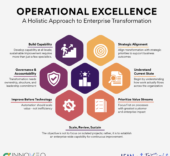
Operational excellence is not achieved through isolated initiatives or standalone programs. It requires a holistic and integrated approach that aligns methodologies, technologies, and organizational culture.
By strengthening process discipline, leveraging digital enablement, and fostering a culture of continuous improvement, organizations can move beyond short-term gains and achieve lasting improvements in performance, quality, and customer value.
#LeanSixSigma
#OperationalExcellence
#ProcessImprovement
#DigitalTransformation
#ContinuousImprovement
#INNOVEO
#LEANInsight
About the Author
Dr. Marc Hermo IV, DBA, CLSSMBB, is the founder and Chief Consultant of INNOVEO™ Consulting. He is a Certified Lean Six Sigma Master Black Belt with over 25 years of experience in process improvement, operational excellence, and organizational transformation. In addition to his consulting practice, he serves as a higher education faculty member and researcher, with scholarly interests in innovation, organizational transformation, and process intelligence.




Leave a comment