


LEAN InSight
by Dr. Marc Hermo IV, DBA, CLSSMBB
LEAN: Lead. Enable. Accelerate. Nurture.
Lead with vision, clarity, and accountability. Enable people, teams, and processes to perform better. Accelerate improvement, innovation, and measurable results. Nurture a culture of excellence, learning, and continuous improvement.
Operational Excellence: The Strategic Engine of Transformation
In many organizations, operational excellence is still viewed as a support function—something owned by quality teams, process improvement groups, or transformation offices.
That view is increasingly outdated.
In today’s environment, operational excellence is not just about improving processes. It is a strategic management capability—one that ensures strategy is translated into consistent execution, measurable performance, and continuous improvement.
As such, it cannot be delegated to a single function. It must be owned by leadership, enabled by specialists, and embedded across the organization.
When treated as a strategic priority—not a collection of initiatives—it becomes the engine that turns intent into results.
1-From Strategic Intent to Real Advantage
Strategy defines where an organization wants to compete. But advantage is created in how work is executed.
As Michael E. Porter emphasizes, competitive advantage comes from performing activities differently—and better—across the value chain.
Organizations that consistently deliver better quality, lower cost, and faster response build advantages that are difficult to replicate.
The challenge is consistency. Sustained advantage requires more than isolated successes—it requires a system that consistently delivers results.
Strategy sets direction. Operational excellence makes it repeatable.
2-Closing the Gap Between Strategy and Execution
One of the most persistent challenges in organizations is not strategy design—but strategy execution.
Leaders define priorities. Yet at the operational level, processes often remain unchanged, metrics are misaligned, and improvement efforts are disconnected.
Research from McKinsey & Company shows that many transformation efforts fail because initiatives are fragmented and not tied to enterprise priorities.
Operational excellence addresses this by acting as a translation layer. It converts strategy into process-level improvements, aligns metrics with outcomes, and embeds accountability into daily operations.
Frameworks such as Lean Six Sigma become powerful in this context—not merely as tools, but as structured systems for execution.
When operational excellence is strategic, execution becomes intentional—not accidental.
3-Why Digital Transformation Fails Without It
Digital transformation is often approached as a technology investment.
But technology alone does not transform organizations—how work is done does.
Insights from MIT Sloan Management Review and Deloitte show that organizations achieve greater returns when they redesign processes before digitizing them.
This leads to a simple but critical principle:
Automation amplifies the current state of a process.
If the process is inefficient, automation scales inefficiency. If the process is optimized, automation accelerates performance.
Organizations that treat operational excellence as a prerequisite to digital transformation are more likely to achieve meaningful ROI, scalable solutions, and sustainable improvements.
Technology enables. Operational excellence ensures it delivers.
4-Designing for Agility, Not Just Efficiency
Efficiency alone is no longer enough.
Organizations must also be able to adapt quickly without losing control.
The principles outlined by James P. Womack and Daniel T. Jones emphasize flow, responsiveness, and continuous improvement. These are not just operational concepts—they are design principles for agility.
When operational excellence is embedded, processes become flexible rather than rigid, problems are solved at the root, and systems are better able to absorb change instead of breaking under it.
Agility is not speed alone—it is structured adaptability.
5-From Programs to a Way of Working
Many organizations approach improvement as a series of initiatives: a Lean project, a digital program, or a transformation effort.
These can deliver results—but often temporarily.
Drawing from W. Edwards Deming, sustainable performance requires a shift from managing outcomes to improving systems.
When operational excellence is treated strategically:
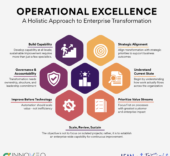
- Leadership sets direction and accountability
- Specialists provide structure, methods, and enablement
- Teams execute and continuously improve
Over time, organizations evolve from executing projects to operating as continuous improvement systems.
The real transformation is cultural.
Conclusion: From Initiative to Imperative
Operational excellence is no longer optional—and it is no longer tactical.
It is a strategic management capability.
Organizations that elevate it to this level:
- align strategy and execution
- maximize the impact of digital investments
- build resilience and adaptability
- sustain performance over time
Those that do not often find themselves with strong strategies—but inconsistent results.
Because in the end, organizations do not compete on strategy alone.
They compete on how well they execute it—every day.
In our next LEAN Insight, we explore how leaders can translate operational excellence into a practical, enterprise-wide transformation roadmap.
#OperationalExcellence #BusinessTransformation #StrategyExecution #ProcessExcellence #LeanSixSigma #DigitalTransformation #ContinuousImprovement #OperationalStrategy #PerformanceExcellence #LEANInSight
References
Deming, W. E. (1986). Out of the crisis. MIT Press.
McKinsey & Company. (2015). Why strategy execution unravels—and what to do about it.
MIT Sloan Management Review, & Deloitte. (2017). Achieving digital maturity: Adapting your company to a changing world.
Porter, M. E. (1996). What is strategy? Harvard Business Review, 74(6), 61–78.
Womack, J. P., & Jones, D. T. (1996). Lean thinking: Banish waste and create wealth in your corporation. Simon & Schuster.
About the Author
Dr. Marc Hermo IV, DBA, CLSSMBB, is the founder and Chief Consultant of INNOVEO™ Consulting. He is a Certified Lean Six Sigma Master Black Belt with over 25 years of experience in process improvement, operational excellence, and organizational transformation. In addition to his consulting practice, he serves as a higher education faculty member and researcher, with scholarly interests in innovation, organizational transformation, and process intelligence.



Leave a comment