

LEAN InSight
by Dr. Marc Hermo IV, DBA, CLSSMBB
LEAN: Lead. Enable. Accelerate. Nurture.
Lead with vision, clarity, and accountability. Enable people, teams, and processes to perform better. Accelerate improvement, innovation, and measurable results. Nurture a culture of excellence, learning, and continuous improvement.
The Human Side of Transformation: Why People Determine Success
Organizations often approach transformation through the lens of strategy, process, technology, and performance. These are all important. A clear strategy provides direction. Well-designed processes create structure. Technology enables speed and scale. Metrics help track progress.
But none of these elements can transform an organization on its own.
At the heart of every transformation are people—the leaders who set direction, the managers who translate priorities into action, and the employees who experience change in their daily work. This is why the human side of transformation deserves deliberate attention. Without it, even the best-designed initiatives can lose momentum, create resistance, or fail to deliver lasting impact.
Transformation is not only a technical or operational journey. It is also a human journey. It affects how people work, how decisions are made, how performance is measured, and sometimes how roles are defined. Even when change is necessary and beneficial, people may still feel uncertain about what it means for them.
This uncertainty is often misunderstood. Resistance is not always a sign that people are against change. More often, it is a signal that people need clarity, involvement, confidence, and support. When organizations recognize this, they begin to see transformation differently. The goal is not simply to push people through change, but to help them understand it, participate in it, and eventually take ownership of it.
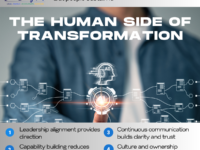
1. Leadership Alignment Provides Direction
Leadership becomes critical when transformation creates uncertainty. People pay attention not only to what leaders announce, but to what they consistently prioritize, measure, reward, and reinforce.
Transformation requires more than executive approval or public endorsement. If leaders say transformation matters but continue to reward old behaviors, employees will follow the old system. If leaders ask for innovation but punish mistakes, people will avoid experimentation. If leaders promote collaboration but manage only through functional silos, cross-functional change will struggle.
For transformation to take root, leaders must model the behaviors they expect from others. They need to demonstrate commitment not only through words, but through decisions, resource allocation, accountability, and daily actions. When leadership is aligned, people gain a clearer sense of direction and a stronger reason to believe that the transformation is real.
2. Continuous Communication Builds Clarity and Trust
Transformation also requires continuous communication. Leaders must communicate not only what is changing, but why it matters, how it will affect people, and how they will be supported.
Communication cannot be treated as a one-time announcement at the start of a program. It must be ongoing, honest, and two-way. People need repeated opportunities to ask questions, raise concerns, and understand how the transformation connects to the organization’s purpose and to their own work.
Clear communication reduces uncertainty. Honest communication builds trust. Two-way communication creates involvement. When people feel informed and heard, they are more likely to engage with the change instead of distancing themselves from it.
3. Capability Building Reduces Resistance
Capability building is essential because employees often resist change not because they are unwilling, but because they are unsure whether they can succeed under new ways of working.
Training, coaching, mentoring, and guided practice help build confidence. When people understand the tools, methods, and expectations, they are more likely to participate meaningfully. Capability building gives people the ability to move from awareness to action.
This is especially important in process improvement, automation, analytics, and AI-enabled transformation. As work becomes more digital, people need to see technology not simply as a threat, but as an enabler of better work. That requires helping them understand new roles, new skills, and new ways of creating value.
When organizations invest in capability building, they reduce fear and increase readiness. People become more confident not only in using new tools, but in contributing to the transformation itself.
4. Culture and Ownership Sustain Transformation
Ultimately, sustainable transformation depends on culture. Processes can be redesigned, technologies can be implemented, and operating models can be changed. But unless new behaviors become part of the way people think and work, transformation remains temporary.
A strong transformation culture encourages learning, problem-solving, collaboration, and ownership. It creates an environment where people are not merely asked to comply with change, but are invited to help shape it.
This shift from compliance to ownership is what turns transformation from a management initiative into an organizational capability. When people take ownership, transformation becomes part of daily work rather than a separate program. It becomes embedded in how teams solve problems, improve processes, use technology, and deliver value.
Conclusion
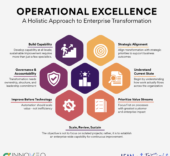
The human side of transformation is not separate from operational excellence. It is what makes operational excellence sustainable. People improve processes. People use technology. People solve problems. People sustain culture.
In the end, organizations do not transform simply because a roadmap exists or a system is implemented. They transform when people understand the purpose, believe in the direction, develop the capability to contribute, and take ownership of the change.
Technology may enable transformation. Processes may structure it. Metrics may track it. But people sustain it.
References
Hiatt, J. M. (2006). ADKAR: A model for change in business, government and our community. Prosci Research.
Kotter, J. P. (1996). Leading change. Harvard Business School Press.
Schein, E. H. (2010). Organizational culture and leadership (4th ed.). Jossey-Bass.
Senge, P. M. (2006). The fifth discipline: The art and practice of the learning organization (Rev. ed.). Doubleday/Currency.
About the Author
Dr. Marc Hermo IV, DBA, CLSSMBB, is the founder and Chief Consultant of INNOVEO™ Consulting. He is a Certified Lean Six Sigma Master Black Belt with over 25 years of experience in process improvement, operational excellence, and organizational transformation. In addition to his consulting practice, he serves as a higher education faculty member and researcher, with scholarly interests in innovation, organizational transformation, and process intelligence.



Leave a comment