
LEAN InSight
by Dr. Marc Hermo IV, DBA, CLSSMBB
LEAN: Lead. Enable. Accelerate. Nurture.
Lead with vision, clarity, and accountability. Enable people, teams, and processes to perform better. Accelerate improvement, innovation, and measurable results. Nurture a culture of excellence, learning, and continuous improvement.
Operationalizing Excellence: A Human-Centered Roadmap for Enterprise Transformation
Many organizations believe in the idea of operational excellence, but the real challenge lies in turning that belief into a practical roadmap that actually works across the entire company. Without a clear path, transformation efforts often lose momentum—projects stay disconnected, new tools don't solve the right problems, and "excellence" becomes a collection of activities rather than a shared way of working. To make these changes stick, we need to move away from isolated tasks and build an integrated roadmap that connects our strategy, people, and technology.
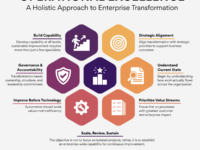
1-Start with Your "Why" (Strategic Alignment)
Before we dive into new projects or select shiny new tools, we need to be clear about what we are actually trying to achieve. Are we trying to make our customers’ lives easier, reduce our costs, or make our team more resilient?. Without this focus, improvement work can easily become "busy work". When we align our efforts with our biggest business goals, operational excellence becomes a disciplined way to deliver on our strategic priorities. This reflects the insights of Porter (1996) and Sull, Homkes, and Sull (2015), who emphasize that strategy requires clear choices, coherent priorities, and disciplined execution across the organization.
2-Get Real About Your Current State
A good roadmap has to be grounded in the reality of how work actually gets done. We need to take an honest look at where work gets stuck, where handoffs break down, and where our customers are feeling the most friction. The goal isn't to map every tiny detail in a spreadsheet, but to find the critical gaps that are preventing us from doing our best work.
3-Focus on What Matters Most (Value Streams)
We simply can't fix everything at once, and trying to do so usually leads to burnout. Instead, we should focus our energy on the "value streams" that matter most to our customers and our strategy—like how we onboard new clients or deliver our core services. By starting with these high-impact areas, we create visible wins that build the confidence and momentum the team needs to keep going. This focus on the value stream is central to Lean Thinking, where Womack and Jones (1996) emphasize defining value, identifying the value stream, creating flow, establishing pull, and pursuing perfection.
4-Fix the Process Before Adding the Tech
It’s tempting to think a new app or AI tool will solve our problems, but technology should be an accelerator, not a "band-aid" for a broken process. If we automate an unstable or unclear process, we are often just scaling inefficiency. We should simplify and standardize our work first; then, we can use technology to scale and sustain those gains. This approach is consistent with Kane et al. (2017), whose MIT Sloan Management Review and Deloitte study emphasizes that digital maturity depends less on technology alone and more on organizational capabilities, leadership, culture, and adaptability.
5-Stay on Track Together (Governance & Accountability)
We need a simple way to manage this journey so it doesn't lose steam. This means being clear about who is making decisions, how we’ll review our progress, and who "owns" the performance of our end-to-end processes. Excellence shouldn't be the job of a single central team; it requires leaders to own the agenda and frontline teams to execute the improvements. This emphasis on leadership, constancy of purpose, and systemic improvement aligns with Deming’s (1986) view that quality transformation requires management responsibility, continuous improvement, and organization-wide participation.
6-Empower the Whole Team (Capability Building)
True transformation can't rely on just a few experts. We need to build problem-solving skills at every level of the company. This means executives learning how to support the work, managers learning how to coach, and frontline teams being equipped to fix issues as they happen in their daily routines.
7-Keep Growing and Learning (Scale & Sustain)
A roadmap doesn't end just because a project is launched. We need to regularly check in on our progress, learn from what worked (and what didn't), and make continuous improvement a natural part of how we operate every day. The goal is to move beyond one-time initiatives and build a lasting enterprise capability that helps us adapt and perform over the long haul.
References
Deming, W. E. (1986). Out of the crisis. MIT Press.
Kane, G. C., Palmer, D., Phillips, A. N., Kiron, D., & Buckley, N. (2017). Achieving digital maturity: Adapting your company to a changing world. MIT Sloan Management Review and Deloitte University Press.
Porter, M. E. (1996). What is strategy? Harvard Business Review, 74(6), 61–78.
Sull, D., Homkes, R., & Sull, C. (2015). Why strategy execution unravels—and what to do about it. Harvard Business Review, 93(3), 57–66.
Womack, J. P., & Jones, D. T. (1996). Lean thinking: Banish waste and create wealth in your corporation. Simon & Schuster.
About the Author
Dr. Marc Hermo IV, DBA, CLSSMBB, is the founder and Chief Consultant of INNOVEO™ Consulting. He is a Certified Lean Six Sigma Master Black Belt with over 25 years of experience in process improvement, operational excellence, and organizational transformation. In addition to his consulting practice, he serves as a higher education faculty member and researcher, with scholarly interests in innovation, organizational transformation, and process intelligence.



Leave a comment