
SPOTLIGHT: Why IIBLC Certification Matters in Lean Professional Development
In today’s competitive and fast-evolving business environment, organizations need professionals who can do more than understand Lean concepts in theory. They need individuals who can apply Lean principles with discipline, credibility, and measurable impact. This is where certification becomes valuable—and why the International Independent Board for Lean Certification (IIBLC®) continues to stand out as a respected name in Lean certification.
Founded in 2008, IIBLC® was established to provide an objective, neutral, and internationally recognized certification standard in Lean. Its mission is to offer independent proof of knowledge and skills in Lean strategy and implementation across a wide range of environments, including manufacturing, services, healthcare, and engineering. Unlike training providers, IIBLC® functions as an independent certification body, separating certification from training delivery.
One of the distinguishing features of IIBLC® certification is its emphasis on independence and rigor. Candidates are not required to complete training from a particular provider before taking the exam. In fact, IIBLC® explicitly states that training is not a prerequisite, reinforcing its role as an impartial certifying organization rather than a training vendor. This makes the credential especially meaningful for professionals and employers seeking objective validation of Lean capability.
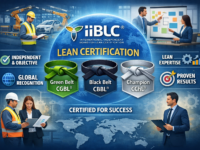
IIBLC®’s certification framework follows a step-by-step progression across three levels: Certified Green Belt in Lean (CGBL®), Certified Black Belt in Lean (CBBL®), and Certified Champion in Lean (CChL®). The Green Belt level focuses on basic concepts and techniques and qualifies a professional to participate in improvement teams. The Black Belt level covers more advanced tools and human skills and requires both a written test and a practical case study, preparing the candidate to lead improvement teams. The Champion level is intended for higher management and includes strategic planning, supply chain management, Lean culture, portfolio management, and program management, again combining written examination with practical application.
Another strength of the IIBLC® system is its structured and standardized assessment model. The certification program is based on a Book of Knowledge (BOK) and uses written proficiency tests organized through accredited exam centres. For higher certification levels, candidates must also submit reports of real-world Lean application, which may be subject to audit. This reinforces not only theoretical understanding but also practical competence in applying Lean principles within organizations. IIBLC®’s current BOK version is September 2025, according to its official FAQ and news pages.
For professionals, IIBLC® certification offers a way to demonstrate capability beyond attendance in a training class. For organizations, it provides greater confidence that certified individuals have met a recognized external standard. And for the broader Lean community, it helps promote consistency, professionalism, and international benchmarking in Lean practice. IIBLC® states that its certification program is already available in more than 10 countries across 4 continents, with exams administered through accredited exam centres.
At INNOVEO, we believe that professional certification plays an important role in building competence, credibility, and lasting impact in process improvement. For individuals and organizations serious about Lean, IIBLC® certification represents more than a credential—it is a commitment to objective standards, disciplined practice, and continuous improvement.




Leave a comment